

Timeline
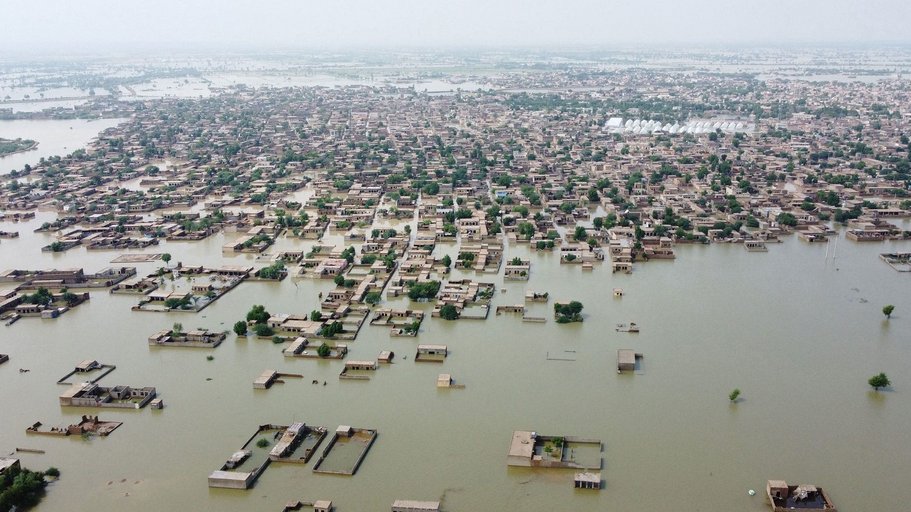
The Devastation
In the summer of 2022, unprecedented extreme rainfall left one-third of Pakistan nearly completely under water for months. At least 1,700 people lost their lives. Thirty-three million people were left homeless and, following contamination of the groundwater and soil, were deprived of their livelihoods. Homes, roads, and schools were destroyed. In the largely agricultural province of Sindh, the floodwaters ruined more than a year’s worth of crops. Livestock that did not die in the floods often perished due to the ensuing lack of food and clean drinking water. The immediate damage amounts to at least 30 billion USD.
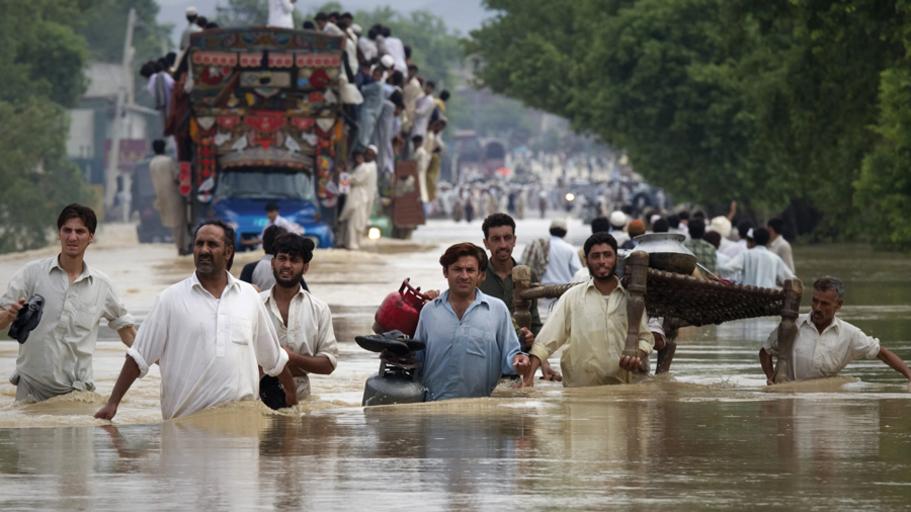
Emergency aid, reconstruction and medico trip to the affected areas
Immediately after the flood, medico international, NTUF, and HANDS provide emergency aid in the affected areas. In the fall, medico representatives make their first trip to Pakistan after the flood. Large parts of Sindh Province are still flooded.
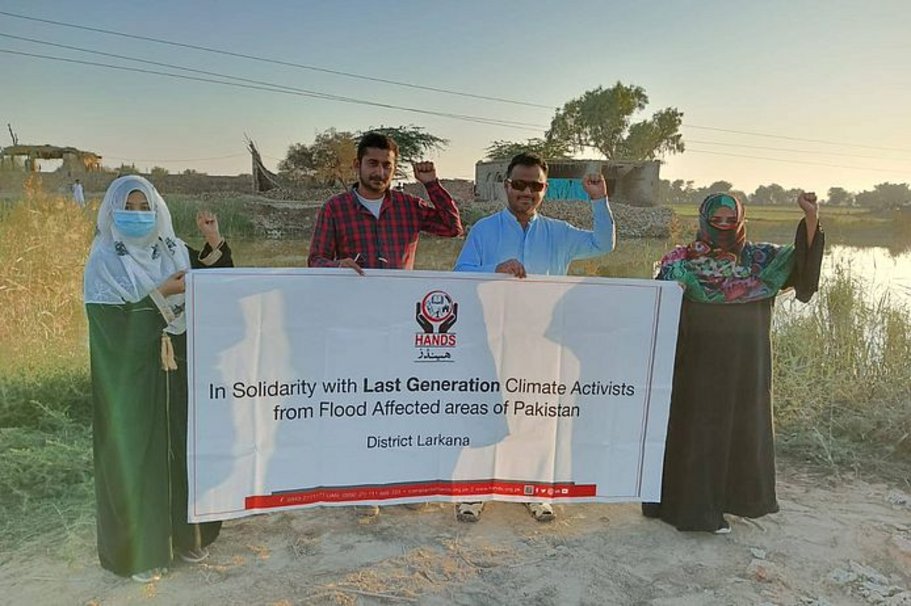
Solidarity with The Last Generation
As water still stands in the fields in Pakistan, a §129 preliminary investigation is being opened against the climate activists of Last Generation in Germany. Pakistani farmers are spontaneously showing solidarity.
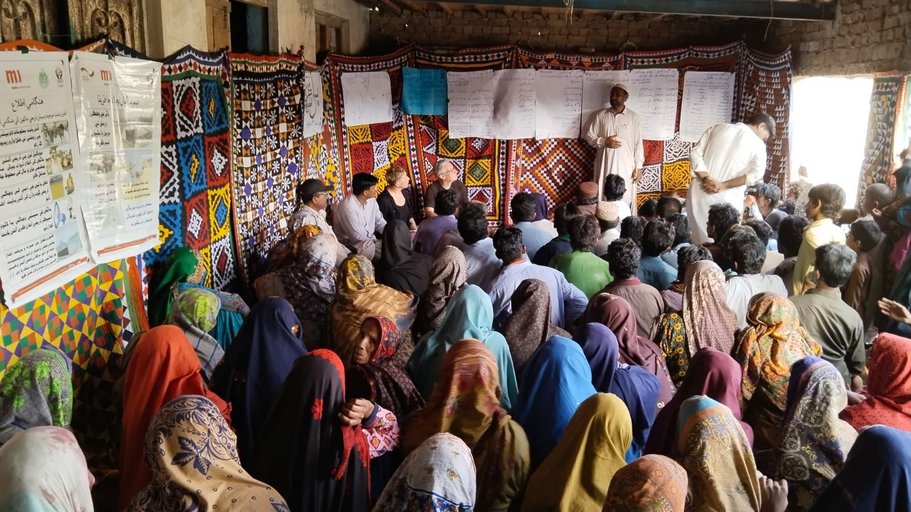
The Climate Justice Comitees
For months, women and men from villages across the Sindh region have been meeting in climate justice committees. They are educating themselves and sharing their knowledge about the causes of observed weather phenomena with their neighbors and relatives. At the same time, they are making every effort at the local level to promote adaptation strategies: knowledge about heat-resilient seeds, the production of organic fertilizer, the cultivation of salinized soil, and the construction of flood-resistant houses. Together, they are developing solidarity-based solutions to combat the disaster.

Why climate justice is not just about reducing greenhouse gas emissions
Climate justice goes far beyond simply reducing greenhouse gas emissions. We need an inclusive, human rights-based approach to climate justice that also addresses the root causes of the climate crisis.

Heat and Garment Workers' Rights: Fashioning a Just Transition
Pakistan belongs to the countries most reliant on garment exports and highly exposed to heat. Governments, suppliers, and brands must act to prevent exposing garment workers to dangerous temperatures, financial insecurity, and uncertain futures.

RWE and Heidelberg Materials served with formal notice
Dozens of farmers from the Sindh region of Pakistan are filing claims for damages against RWE and Heidelberg Materials after floods in 2022 led to a climate disaster.
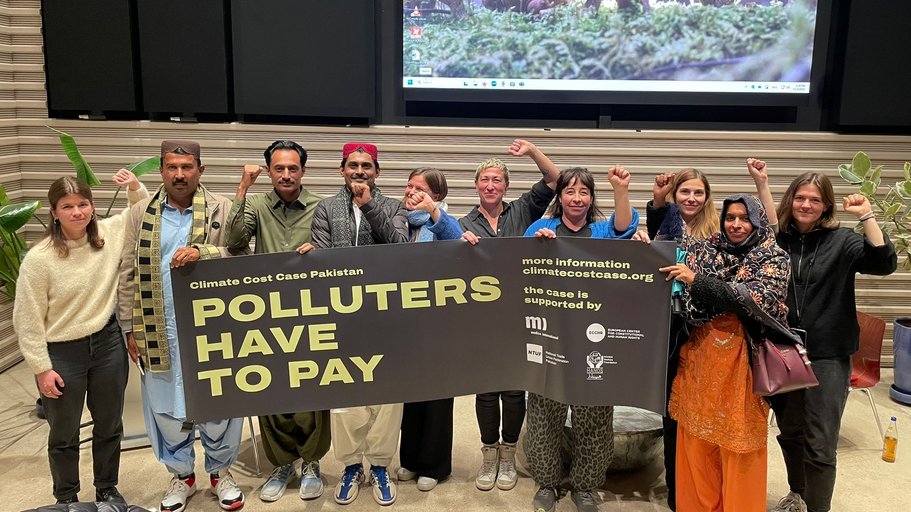
Delegation of Farmers from Sindh visit Germany
Representatives from the most impacted communities in Sindh are traveling to Germany. At events in Cologne, Berlin, the Wendland, and Hamburg, they raise awareness about their reality in Pakistan, voice their demands for compensation, and build networks with local agricultural cooperatives and climate groups.
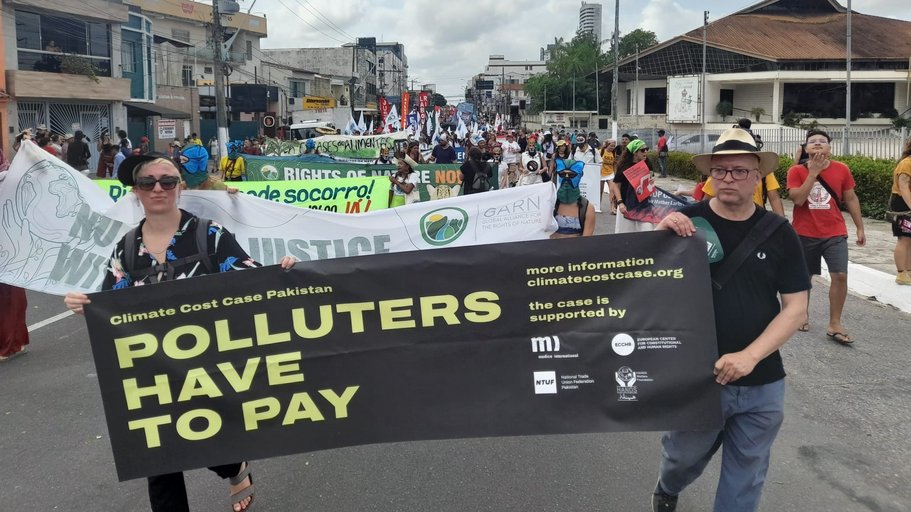
Calls for Compensation at the COP 30 and the Cúpula dos Povos in Belém
At the COP 30 in Belém, medico international and ECCHR are presenting the demands of Pakistani farmers. At the Cúpula dos Povos, which is taking place at the same time, the organizations are pushing for climate justice and reparations as part of the global climate movement.
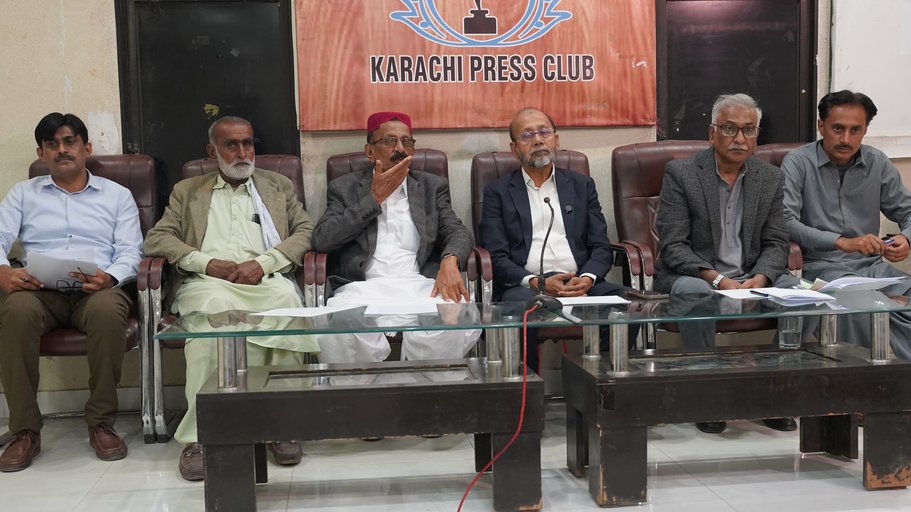
Press Conference by NTUF und HANDS
At a press conference held by the Pakistani grassroots organization HANDS and the NTUF labor union, the farmers present their demands. This generates strong responses, particularly in Arabic- and English-language media.
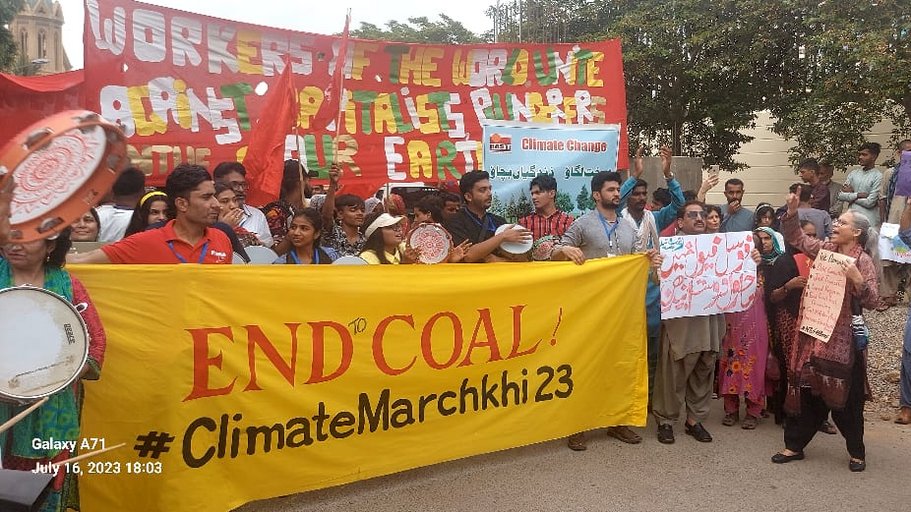
Climate March in Karachi
Pakistani farmers participate in the Climate March 2025 in Karachi, which is organized by the NTUF labor union. The demonstration calls for an end to fossil fuels, reparations from the Global North, and debt relief.
Lawsuit filed: 39 farmers from Pakistan take RWE and Heidelberg Materials to court
39 farmers from the Sindh region in Pakistan are filing a lawsuit at the German Regional Court in Heidelberg against two of Germany’s largest climate polluters, RWE and Heidelberg Materials. The farmers are seeking partial compensation for the devastating losses they suffered during the catastrophic floods that hit Pakistan in 2022 - floods that destroyed homes, land, and livelihoods across the country. Previously, RWE and Heidelberg Materials had rejected the claims and any assumption of liability in writing.
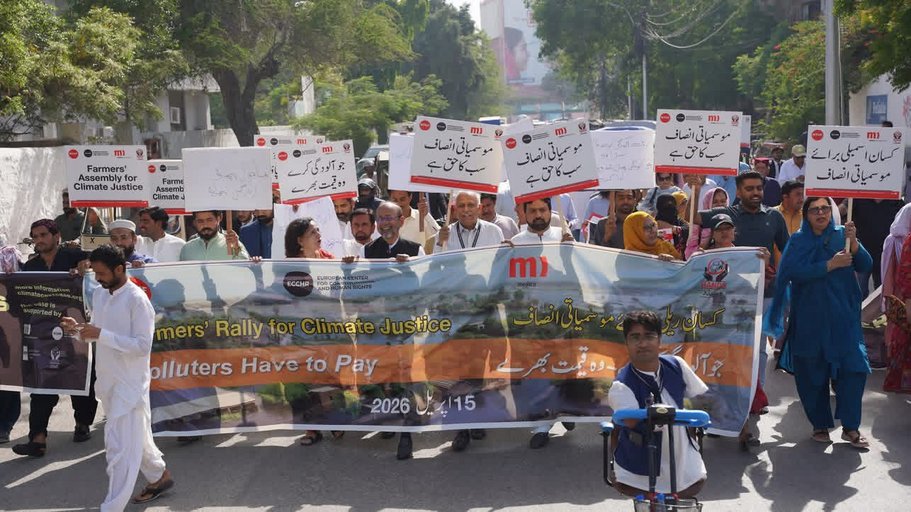
Farmers’ Assembly for Climate Justice in Karachi
More than 300 Pakistani farmers are calling on national policymakers and the international community to recognize climate-related losses and damages and to hold carbon majors accountable at an assembly and subsequent demonstration in Karachi, Pakistan.
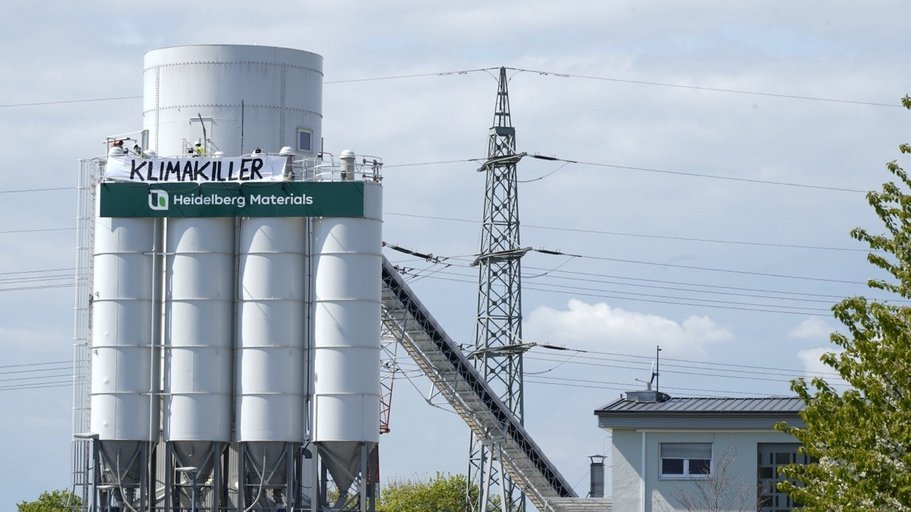
Public Protest Against Heidelberg Material
During the Endcement protests against Heidelberg Materials, medico presents the case of the farmers from Pakistan at a panel discussion featuring activists from Indonesia and Western Sahara.
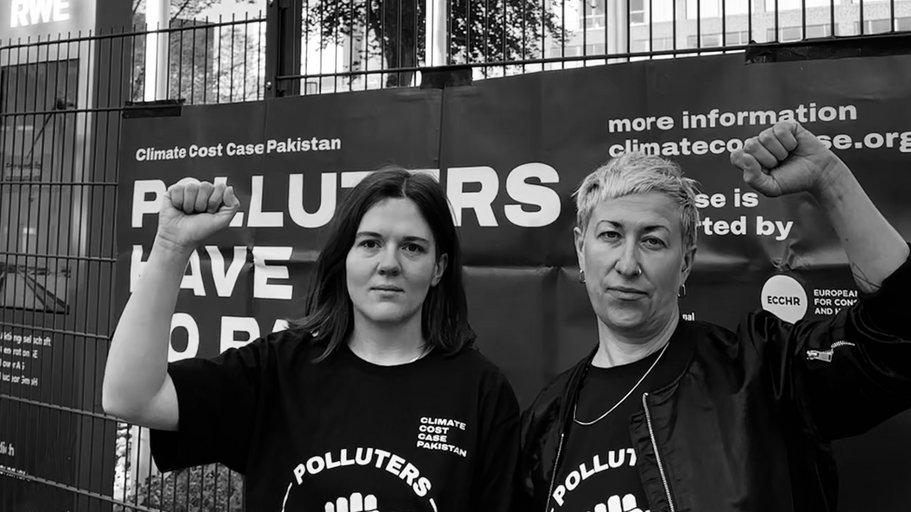
Action taken at RWE's Annual Shareholders' Meeting
medico international participates in the protest held during RWE’s annual shareholders’ meeting and, together with the ECCHR and the Association of Ethical Shareholders, is submitting a motion calling on Heidelberg Materials to use its balance sheet provisions to compensate for damages caused by the 2022 climate crisis-induced disaster in Pakistan.
Counter-Motion at Heidelberg Material’s Annual Shareholders' Meeting
Together with the Association of Ethical Shareholders, ECCHR and medico international are submitting a motion calling on Heidelberg Materials to use its balance sheet provisions to compensate for damages caused by the 2022 climate crisis-induced disaster in Pakistan.
FAQ
The case is about justice for the 39 farmers. It seeks to address real damage done to real people, who are seeking monetary compensation from those who caused and contributed to the damage. For medico international and ECCHR the aim is to support the farmers from Sindh in seeking accountability for the rights violations they have suffered as a result of the climate crisis.
The devastation caused by the 2022 floods in Pakistan stands as a stark reminder of how deeply climate-related damage can affect both individuals and entire societies. The compensation claim lodged by Pakistani farmers highlights the perspectives of those most affected by the crisis and carries their fight for justice to those responsible in Germany.
Their case will bring a new voice in a broader, transnational demand for a global legal framework that holds the perpetrators of the climate crisis accountable. Major polluters must take responsibility for the consequences of the damage their actions have caused.
The claim is addressed to RWE, one of the largest electricity producers in Europe, and Heidelberg Materials, one of the major cement producers worldwide.
The term “Carbon Majors” refers to companies that have contributed significantly to climate change. The term was coined by studies conducted by the Climate Accountability Institute, which found that just over 100 companies are responsible for nearly 70% of global historical industrial greenhouse gas emissions. RWE and Heidelberg Materials are two of them. As Carbon Majors, they are responsible for a significant proportion of global industrial greenhouse gas emissions.
Historically, both companies are among the top carbon emitters worldwide and among the two biggest polluters with headquarters and major operations in Germany. The latest studies utilizing the Carbon Majors methodology show that RWE is responsible for at least 0.68% and Heidelberg Materials 0.12% of global industrial emissions since 1965.
Major corporate emitters have thus far managed to avoid genuine accountability. Holding them to account in court is the only avenue left to ensure that those who contributed significantly to the crisis bear their fair share of its costs, instead of leaving all these costs to affected communities.
The case builds upon the legal foundations established in the Saúl Luciano Lliuya v. RWE case, where a German court accepted in principle that a major emitter could be held liable for climate-related damages abroad.
All 39 farmers involved come from Sindh Province, the region in southern Pakistan most affected by the unprecedented floods of 2022. They live in three different districts: Jacobabad, Dadu and Larkana. Their survival is based on the crops they produce on their small plots of land and they struggle to maintain their independence from large landowners and agricultural corporations. They have been exposed to changing weather patterns and the destruction of their livelihoods caused by climate change for many years.
The 39 farmers demanding compensation from RWE and Heidelberg Materials are supported by 10,000 farmers from their village communities. Their fight for climate justice highlights the situation of 33 million people affected by the 2022 flood disaster in Pakistan, as well as many other communities around the world that are already impacted by the climate crisis.
The 39 farmers in Pakistan are not alone facing RWE and Heidelberg Materials. More than 10,000 people in their villages are supporting them. They are assisted locally by the socio-medical aid organization HANDS Welfare Foundation and the trade-union federation NTUF.
The National Trade Union Federation (NTUF) empowers farmers in conflicts on land and labor rights. The HANDS Welfare Foundation works in rural Sindh communities on the transition to climate-adapted agriculture and supports village self-organization.
For decades, both organizations, supported by medico international, have been working to improve working and living conditions in Pakistan. In their pursuit of justice, medico international and the human rights organization ECCHR stand firmly by their side.
There is a broader struggle for climate justice, in which the people of Pakistan are also fighting, beyond the legal arena, to safeguard their livelihoods. They are combining legal action with political demands for support in reconstruction, food sovereignty, and debt relief.
Farmers are directly affected by the changing living conditions and the growing impossibility of sustaining life in their region. Without justice, their future prospects will become increasingly bleak.
At the same time, they are aware that their villages are only a few of many worldwide that are exposed to the same devastation in the context of the climate crisis: Many people in Pakistan, and across the world are threatened in their existence and human rights by the destructive fossil fuel based economic model and the climate crisis.
All people have the same right to live in dignity and self-determination, and to a healthy environment that makes this possible. Yet the impacts of the climate crisis are eroding these very foundations. The burden of climate-related damage is far from evenly shared: those who have contributed least to global warming are often the ones who suffer its effects most severely. The main culprits and beneficiaries of global warming—high-emission corporations and industrialised nations—are typically less affected and possess far greater means to shield themselves from disaster. But the climate crisis is not a natural phenomenon; it has perpetrators and profiteers who must be held accountable.
Taking the “polluter pays” principle seriously means recognizing their particular responsibility—not only to drastically and rapidly reduce emissions, but also to address the consequences of the crisis. This includes both material and immaterial damage, as well as climate-related human rights violations. Ultimately, climate justice means dismantling the structures that perpetuate inequality and injustice.
The Pakistan climate cost case is part of a growing movement for climate justice worldwide. Several actions have been filed for climate reparations against major polluters.
Most recently, on 23 October 2025, the Odette case was launched: 67 Odette typhoon survivors from island communities in the Philippines sent a formal notice to the fossil fuel company Shell demanding financial compensation for the losses and damage they experienced under Odette. It is an unprecedented lawsuit in the UK and globally, as the first civil claim to directly link polluting companies to deaths and personal injuries that have already happened in the global south.
ECCHR is already supporting residents of Pari Island in their lawsuit filed in Switzerland against HOLCIM. In December 2025, the court in Zug declared the lawsuit admissible, meaning that the case will now proceed to substantive assessment.
In Belgium, through the farmer case, a farmer is asking the court to demand TotalEnergies to repair the damage he has suffered and make a financial contribution to the green transition. He is also asking judges to oblige the company to move away from fossil fuels in order to prevent future damage.
In Germany, the 28 May 2025 decision in the Saúl Luciano Lliuya v. RWE case confirmed the legal principle that major emitters can be liable for transboundary harms.
Solidarity matters. The Pakistani farmers will need plenty of it as they embark on this legal battle.
Their country has been hit especially hard by the impacts of the climate crisis, yet they know many others are facing the same fate. When people, organizations and initiatives share their story, talk about their struggle and spread the message, this support makes a difference.
Information materials about the case are available free of charge in English and German and can also be shared on social media. [links provided]. medico international and ECCHR, the supporting organizations in Germany, are available for talks and events.
Donations are also welcome, and they help fund medico international’s ongoing work in Pakistan, supporting community-led climate adaptation, education, and reconstruction projects.